Gym Acoustics: How to Cut the Echo in a Loud Gym

Gym acoustics are the way sound behaves in a gym, and most gyms are built to make it bounce. Concrete floors, block walls, mirrors and high ceilings throw music, clanking plates and coaching cues back into the room. That build up of echo makes a gym louder and more tiring than it needs to be.
- Gyms echo because almost every surface is hard.
- Group fitness classes have been measured above 90 decibels.
- Turning the music down is still the biggest single fix.
- Acoustic panels cut the echo, so the room needs less volume to sound full.
- Hang panels high enough to stay clear of weights, balls and elbows.
Why gyms are so loud
A gym is basically a big hard box. Rubber floors help with dropped weights, but walls, ceilings and mirrors stay hard and bounce sound everywhere. Every rep, every whistle and every song gets repeated off those surfaces.
That repeated sound is reverberation. It stacks on top of the music, so instructors push the volume up to be heard, and then they shout over that. The room ends up loud and muddy at the same time.
How loud gyms and fitness classes get
Researchers have been measuring this for years. A summary from the American Academy of Audiology reports high intensity fitness classes averaging about 93 decibels in one study. In another, a 60 minute Zumba class averaged about 91 decibels, with peaks over 100.
For comparison, the US National Institute for Occupational Safety and Health sets its recommended limit at 85 decibels averaged over an 8 hour workday. Every 3 decibels above that halves the safe time. That matters most for instructors and staff who are in the room all day.
What acoustic panels can and can't do for gym acoustics
Panels soak up sound that would otherwise bounce off the walls. With less echo piling up, the room sounds clearer, coaching cues carry, and you don't need as much volume to fill the space.
What panels can't do is make loud music safe. If the speakers are cranked, the sound reaching your ears is still loud. Better gym acoustics make it easier to turn the music down, so the two work best together. (Our guide on how acoustic panels work covers the science.)
Where to put acoustic panels in a gym
Every area of a gym has a different noise problem:
- Weight rooms. Panels high on the walls around the free weight area cut the clank and the echo of dropped plates.
- Group fitness studios. Treat the back wall and side walls, and leave the mirror wall alone.
- Spin rooms. These are often small and loud, so panels on every bare wall make a real difference.
- Yoga and stretching rooms. A quieter room is the whole point, so cover as much wall as you can.
- Front desk and lobby. Less echo makes check in and sales chats easier.
Keep panels out of harm's way
Gyms are hard on anything hung on a wall. Mount panels above the reach of swinging kettlebells, medicine balls and barbells. Above roughly head height on walls near the lifting area is a safer bet.
Keep them clear of sprinkler heads, fire exits and exit signs. In ball courts or turf areas, ask about a protective mount or skip that wall altogether.
Other ways to improve gym acoustics
Panels are one piece. These help too:
- Turn the music down and point speakers at the people, not the ceiling.
- Use headset mics for instructors, so they don't shout over the music.
- Add ceiling baffles if the ceiling is high and bare.
- Use thick rubber flooring in the lifting area for impact noise.
- Close studio doors during classes so the noise doesn't spill into the gym floor.
Choosing gym acoustic panels that fit the brand
A gym wall is prime real estate, so the panels might as well look the part. Patterns that repeat edge to edge let a row of panels read as one long feature wall.
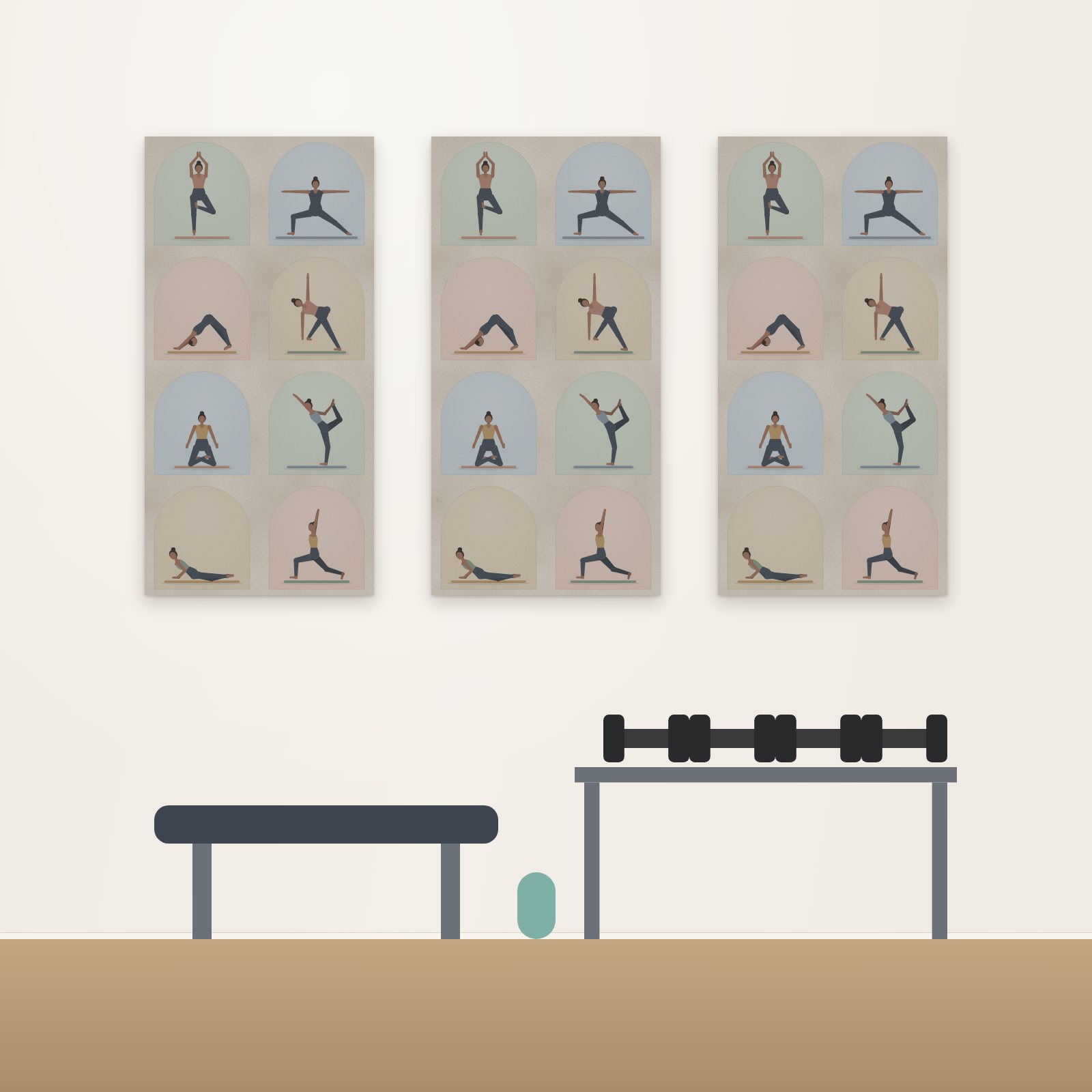
Our Free Weights acoustic panel suits a lifting area, and the softer Yoga Flow acoustic panel suits a studio. You'll find the full range, including spin and track designs, in our gyms and studios collection.
A note on fire rules for gym walls
Gyms are public spaces, and wall finishes there usually have to meet fire rules. In Canada that's often a flame spread rating under ULC S102. Fire testing on our panels isn't confirmed yet, so contact us before ordering for a gym.
Questions people ask about gym acoustics
How do you reduce echo in a gym?
Add sound absorbing panels to the big bare walls, add baffles to a high ceiling, and turn the music down. Rubber flooring helps with impact noise from dropped weights.
Do acoustic panels make a gym quieter?
They make it less echoey, so it sounds clearer and calmer. The music still needs to be at a sensible volume, since panels don't turn down the speakers.
How many acoustic panels does a gym need?
It depends on the size of the room and how hard the surfaces are. Start with a pack along the longest bare wall, then add panels to the facing wall if it still rings. Our acoustic panels for business come in packs of 4, 8 or 12.
Key takeaways on gym acoustics
- Gyms echo because walls, ceilings, mirrors and floors are all hard.
- Fitness classes have been measured at around 91 to 93 decibels on average.
- NIOSH recommends 85 decibels over an 8 hour day, which matters most for staff.
- Panels cut echo so the room needs less volume, but turning the music down still matters most.
- Treat weight rooms, studios and spin rooms differently.
- Mount panels high and away from weights, balls, sprinklers and exits.
- Check fire rules for wall finishes in public spaces.


